Fly over Jupiter’s north pole and you’d find nine giant storms packed together like tiles on a floor. Fly over Saturn’s north pole and you’d find one enormous storm sitting inside a six-sided river of wind wider than two Earths. Same kind of planet, very different weather.
The Jupiter polar cyclones and Saturn’s hexagon are two of the strangest weather systems in the solar system, and they were only seen properly in the last two decades, by spacecraft looking straight down from above. In 2026 the story got even stranger: the Hubble Space Telescope caught a brand-new 10-sided pattern forming around Saturn’s south pole.
This guide walks through what NASA’s Juno and Cassini missions actually saw, how big these storms are, and the leading ideas for why the two planets behave so differently. As always at Dark Cosmic Insights, we keep three things separate: what spacecraft have observed, what has been measured, and what is still a model or an open question.
In this guide
- Quick Answer: How Are Jupiter’s and Saturn’s Poles Different?
- The DCI Polar Storms Evidence Map
- Why Can’t We See Jupiter’s Poles From Earth?
- What Did Juno Find at Jupiter’s Poles?
- How Did Jupiter’s Pentagon Become a Hexagon?
- What Is Saturn’s Hexagon?
- What Sits Inside the Hexagon?
- Does Saturn’s South Pole Have a Hexagon Too?
- Side by Side: Jupiter’s Polar Cyclones vs. Saturn’s Hexagon
- Why Don’t the Jupiter Polar Cyclones Merge?
- Why Does Saturn Have One Giant Vortex? The “Soft vs. Firm” Idea
- Why Does Saturn’s Hexagon Have Six Sides?
- How Deep Do These Storms Go?
- Myth vs. Fact: Polar Storm Edition
- Can You See Jupiter’s or Saturn’s Poles Yourself?
- What Comes Next for Jupiter and Saturn’s Poles?
- Polar Storms by the Numbers
- Frequently Asked Questions
- Sources and Further Reading
- Keep Exploring
Quick Answer: How Are Jupiter’s and Saturn’s Poles Different?
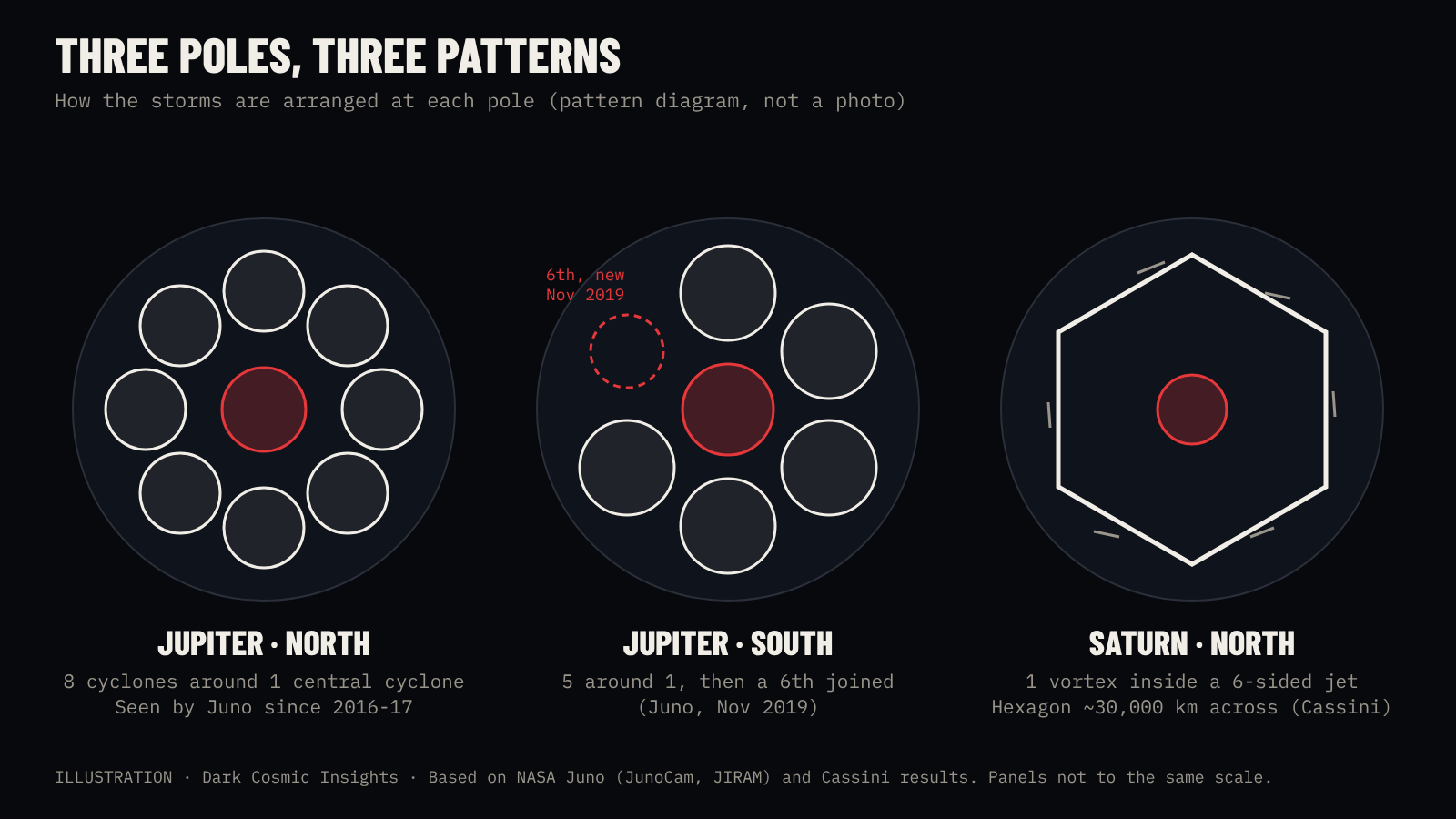
Quick Answer: Jupiter has a cluster of cyclones at each pole: eight storms circling one central cyclone in the north, and five (now six) circling one in the south, each thousands of kilometres wide. Saturn has one giant vortex at each pole. In the north, that vortex sits inside a six-sided jet stream, the hexagon, about 30,000 km (20,000 miles) across. Nobody knows for certain why the planets differ. Leading models point to how big each polar vortex can grow and to how “soft” or “firm” the layers beneath the clouds are.
What this article can and cannot establish: We can describe what Juno, Cassini and Hubble have photographed and measured, with sources for every number. We can’t tell you the final answer to why the patterns differ, because the explanations below are computer models and lab experiments, not direct measurements. Where an idea is a model, we say so.
The DCI Polar Storms Evidence Map
Not every claim about these storms is equally solid. This map sorts the big questions by how well they’re supported.
| Question | What we know | Status | Key source |
|---|---|---|---|
| How many cyclones sit at Jupiter’s poles? | 8 around 1 in the north; 5 around 1 in the south, 6 around 1 since Nov 2019 | Observed | Adriani et al. 2018; NASA PIA23608 |
| How big and fast are they? | Roughly 4,000–7,000 km wide, peak winds about 100 m/s | Measured | NASA/JPL 2018; Grassi et al. 2018 |
| Is Saturn’s hexagon real? | Yes: a six-sided jet stream seen since 1980–81 | Observed | Voyager; Cassini (NASA 2013) |
| Does the hexagon reach above the clouds? | A matching hexagon appears in the stratosphere | Measured | Fletcher et al. 2018 |
| Does Saturn’s south pole have a pattern too? | A 10-sided wave has been growing since about 2023 | Observed (new) | Sánchez-Lavega et al. 2026 |
| Why don’t Jupiter’s cyclones merge? | A balance of two “pushes” may hold them in a ring | Modelled | Gavriel & Kaspi 2021 |
| Why does Saturn have one giant vortex? | Maybe a firmer, denser layer underneath lets one vortex grow huge | Modelled | Shi & Kang 2026 (PNAS) |
| Why exactly six sides? | A wave in a jet stream; several competing models | Open | Fletcher et al. 2018; Yadav & Bloxham 2020 |
Status key: Observed = seen directly in spacecraft or telescope images; Measured = quantified from data; Modelled = reproduced in simulations or lab experiments; Open = still debated.
Cite this framework: Dark Cosmic Insights, “Polar Storms Evidence Map,” darkcosmicinsights.com, 2026.
Same size class, same ingredients, same fast spin. Completely different weather at the top of the world.
Why Can’t We See Jupiter’s Poles From Earth?
You’d think the tops of the two biggest planets would be easy to photograph. They aren’t. Jupiter’s spin axis is tilted only about 3 degrees, so from Earth we always look at it almost exactly side-on. Its poles sit right on the edge of the disk, squashed and foreshortened, and the details are lost.
Most spacecraft didn’t help either. Pioneer, Voyager, Galileo and Cassini all flew roughly in line with Jupiter’s equator, the same plane the planets orbit in. As the Juno team put it, Jupiter’s polar regions were “not visible from Earth” and “poorly characterized by previous missions” (Adriani et al., Nature, 2018).
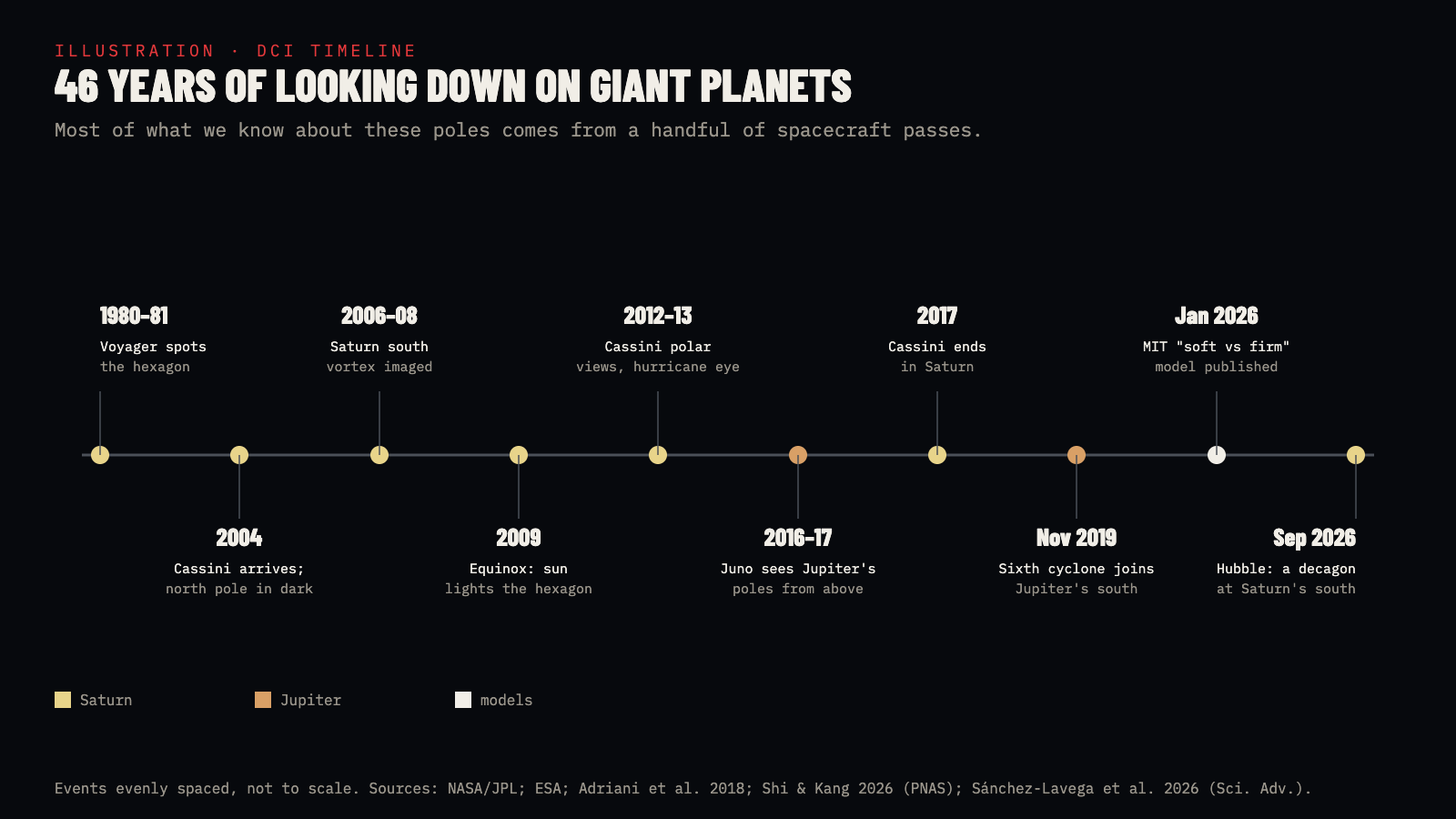
Saturn is a little friendlier. It’s tilted about 27 degrees, so over its 29-year orbit we get to see first one pole and then the other tipped toward us. That’s how Voyager glimpsed the hexagon in 1980 and 1981, and how amateur astronomers spotted the new southern pattern in 2024. But a good view from directly overhead still takes a spacecraft in the right orbit.
Juno, which reached Jupiter on July 4, 2016, was the first spacecraft built to fly over the poles. Its long, looping orbit swings it from pole to pole on every close pass, and it carries a visible-light camera (JunoCam) and an infrared camera (JIRAM) that can see heat escaping through the clouds, even in polar darkness.
What Did Juno Find at Jupiter’s Poles?
On its first few orbits in 2016 and 2017, Juno sent back something no one had predicted: tidy geometric clusters of giant cyclones. A cyclone here simply means a storm that spins in the same direction as the planet’s rotation around a low-pressure center, like a hurricane on Earth.
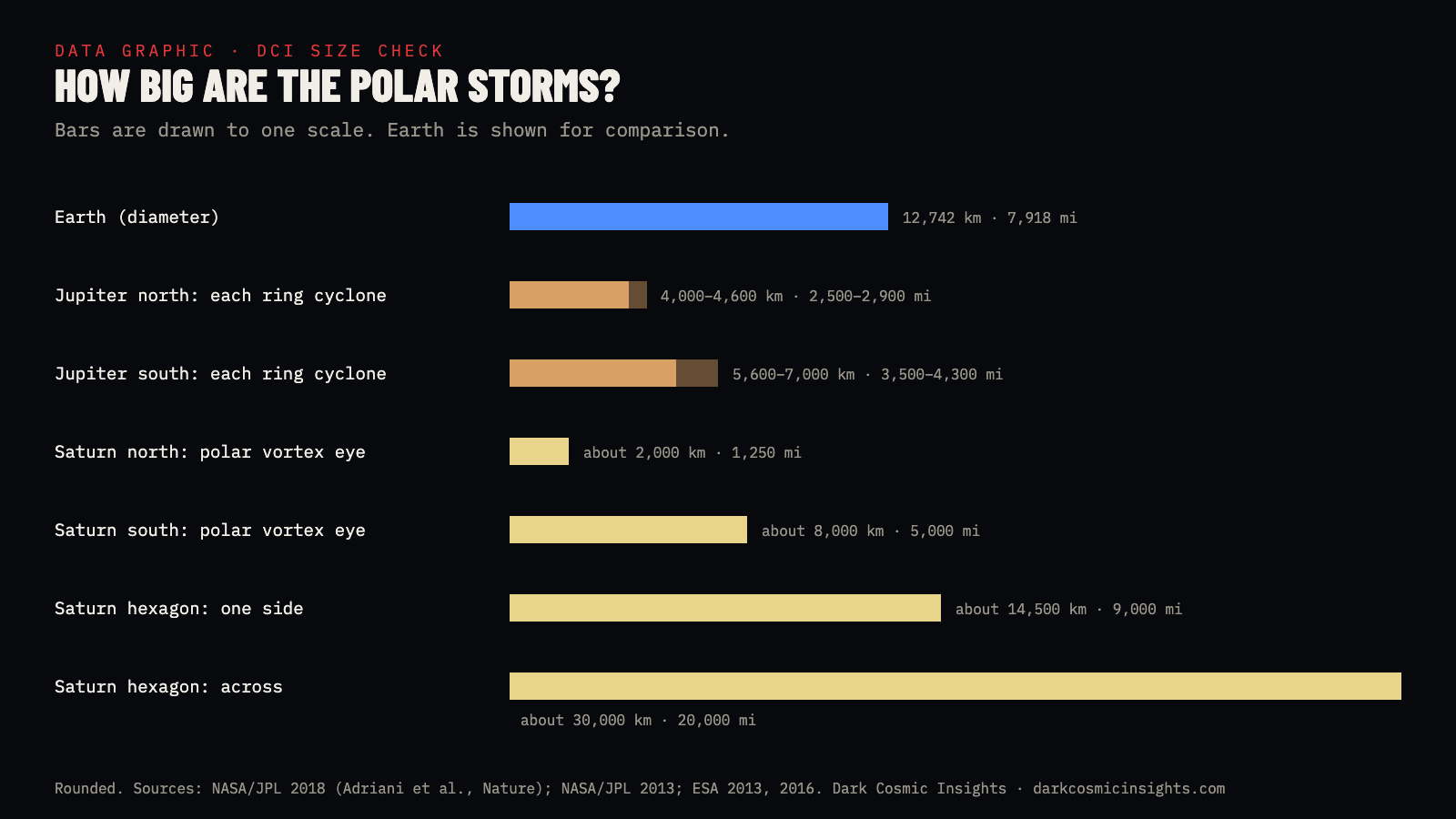
- North pole: one central cyclone surrounded by eight others, arranged like an octagon. Each ring cyclone is about 4,000–4,600 km (2,500–2,900 miles) across (NASA/JPL, 2018).
- South pole: one central cyclone surrounded by five larger ones in a pentagon, each about 5,600–7,000 km (3,500–4,300 miles) across.
- Winds: peak speeds around 80–110 m/s (about 180–250 mph), measured by tracking clouds between JIRAM images, with the fastest winds roughly 1,000 km from each storm’s center (Grassi et al., 2018).
The storms are packed so tightly that their spiral arms touch. On Earth, two hurricanes that get this close tend to dance around each other and merge. Jupiter’s don’t. As Juno scientist Alberto Adriani put it when the results came out: “The question is, why do they not merge?” (NASA/JPL).
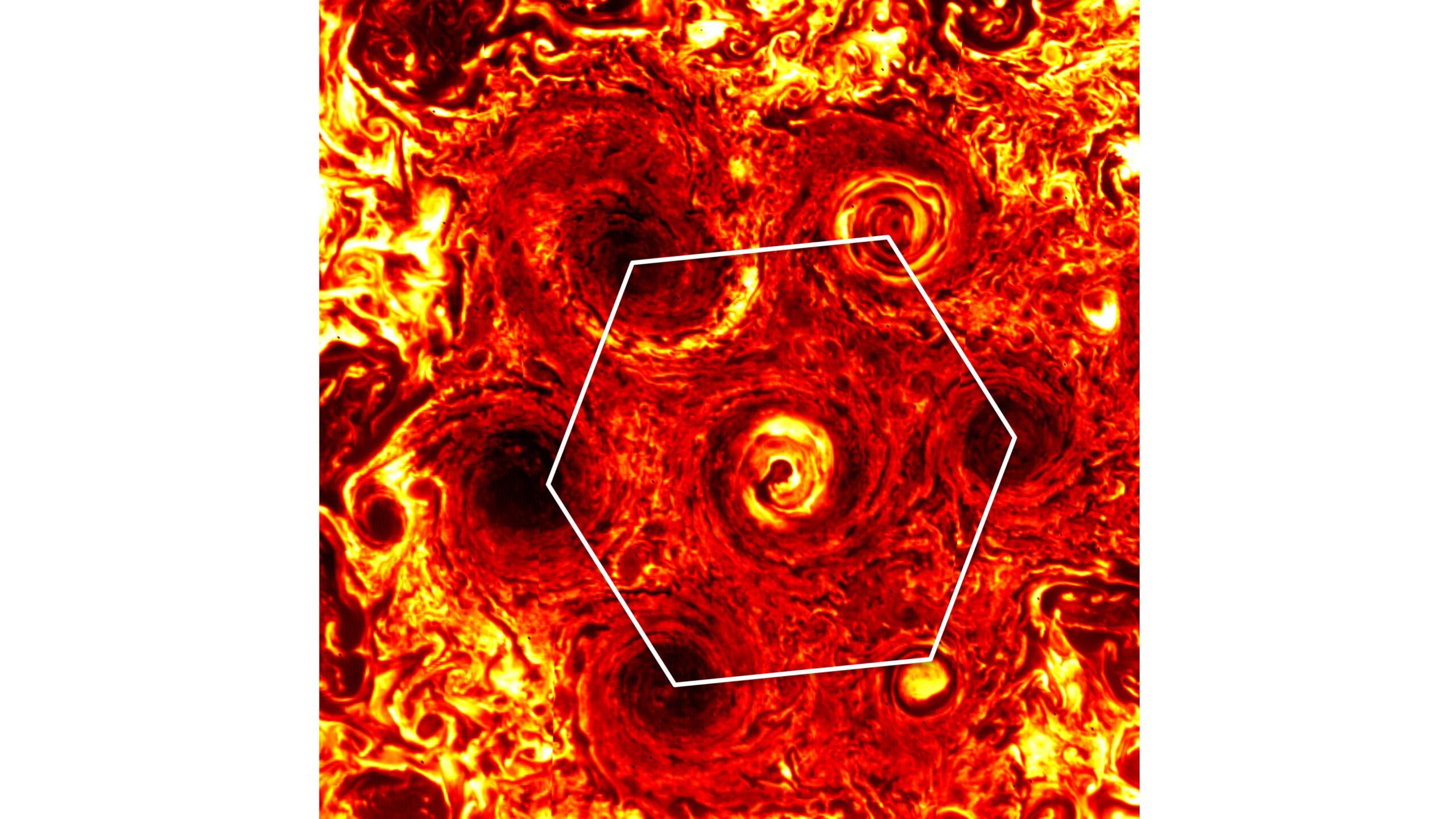
Years of tracking showed the clusters are remarkably stable. The individual storms wobble around their positions, and those wobbles seem to pass from one cyclone to its neighbor, like a ripple through a ring of linked gears (Mura et al., GRL, 2021). The southern ring also drifts slowly westward as a group (Juno mission team, SwRI).
What powers them?
A 2022 study used Juno’s infrared images like a weather satellite, measuring winds and cloud thickness across the north pole. It found that small, intense thunderstorms, a process called moist convection, feed energy upward into the giant cyclones, the way smaller eddies feed big ones in Earth’s oceans (Siegelman et al., Nature Physics, 2022). That’s a measured energy flow, though it explains what keeps the storms spinning, not why they line up in rings.
How Did Jupiter’s Pentagon Become a Hexagon?
In November 2019, Juno caught the southern cluster rearranging itself. A new, smaller cyclone squeezed into the ring, turning the pentagon into a hexagon of six storms around the central one. JunoCam measured its dark core at about 1,400 km across, with a bright outer ring about 2,000 km wide (NASA, PIA23608).
Watching a planet-scale pattern rearrange itself is rare. It gave scientists a natural experiment: any theory of how these clusters stay stable now has to allow a new member to squeeze in without the whole ring falling apart.
This is also why you’ll sometimes read that “Jupiter has a hexagon too.” It’s a coincidence of shape. Jupiter’s southern hexagon is six separate storms arranged in a ring. Saturn’s hexagon is one continuous jet stream bent into six sides. They’re very different things.
What Is Saturn’s Hexagon?
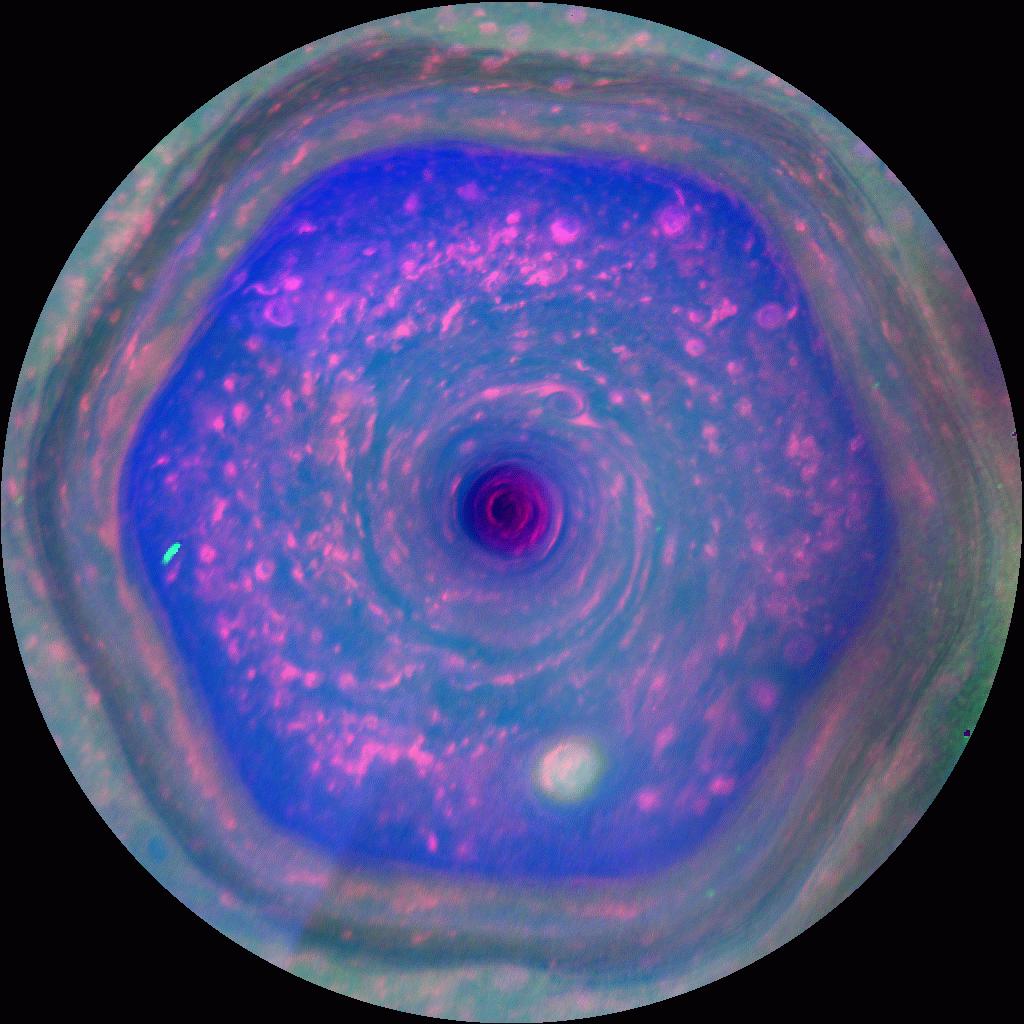
Saturn’s hexagon isn’t a solid object, a crater or a cloud painted on the planet. It’s a jet stream, a fast, narrow river of wind, that runs around the north pole near latitude 77° N in a six-sided path. NASA describes it as about 30,000 km (20,000 miles) across, with winds of about 320 km/h (200 mph) (NASA, 2013). Each straight side is roughly 14,500 km long, wider than Earth.
It was first seen in Voyager images from 1980 and 1981, and it has been there every time anyone has looked since, for more than 40 years. Cassini, which orbited Saturn from 2004 to 2017, gave us the best views, but it had to wait: when it arrived, the north pole was in the middle of its 15-year winter night. Sunlight only bathed the whole hexagon after Saturn’s equinox in August 2009, and Cassini began swinging over the poles in late 2012 (NASA, PIA17652).
Two more Cassini findings make the hexagon even stranger:
- It acts like a wall. Inside the hexagon there are fewer large haze particles and more small ones; outside, the opposite. NASA compared it to Earth’s Antarctic ozone hole, where a jet stream keeps air from mixing in (NASA, 2013).
- It towers above the clouds. As northern summer arrived, Cassini’s infrared instrument found a warm vortex forming high in the stratosphere, hundreds of kilometres up, and its edges were hexagonal too, matching the pattern below (Fletcher et al., Nature Communications, 2018).
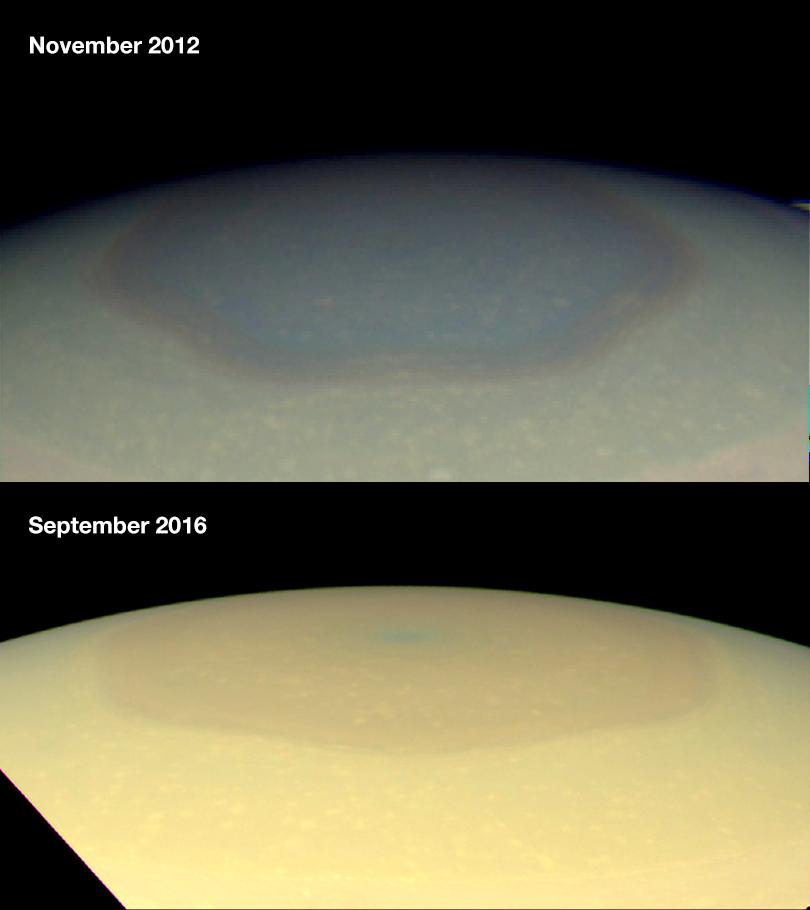
The hexagon also changes color with the seasons. Between 2012 and 2016, the region inside it shifted from blue to gold as summer sunlight produced a photochemical haze, a kind of smog made when ultraviolet light breaks apart methane (NASA, PIA21049).
What Sits Inside the Hexagon?
At the very center of the hexagon sits a single huge cyclone, centered almost exactly on the pole. Its eye is about 2,000 km across, roughly 20 to 50 times bigger than a typical hurricane eye on Earth, depending on which Earth storm you compare it with, and clouds at its edge race at about 540 km/h (ESA, 2013).
Smaller storms ride along inside and around the hexagon, some spinning the opposite way. The biggest Cassini measured there spans about 3,500 km (2,200 miles), roughly twice the size of the largest hurricane ever recorded on Earth (NASA, 2013).
It looks like a hurricane, but it isn’t quite one. Earth’s hurricanes feed on warm ocean water and drift across the map. Saturn has no ocean or surface, and its polar cyclones stay locked to the poles. Cassini scientist Kevin Baines called the northern one “the belly button of Saturn” (NASA).
Does Saturn’s South Pole Have a Hexagon Too?
For decades the answer was no. Saturn’s south pole has its own giant polar vortex, with a dark eye about 8,000 km across, roughly two-thirds the width of Earth, ringed by towering clouds (ESA). But Cassini saw no hexagon or any long-lived many-sided jet around it.
Then, in September 2026, came a surprise. Hubble’s Outer Planet Atmospheres Legacy (OPAL) program, which photographs the outer planets every year, confirmed a 10-sided wave, a decagon, encircling Saturn’s south pole (NASA, 2026). It’s the first large, regular-sided jet pattern ever seen in Saturn’s southern hemisphere.
Amateur astronomers helped find it. Researcher Agustín Sánchez-Lavega and amateurs Trevor Barry and Jean-Paul Oger first noticed a wavy band near the south pole in ground-based images in 2024, and Hubble’s archive then traced it back to 2023 (ESA/Hubble). The results were published in Science Advances (Sánchez-Lavega et al., 2026).

Unlike the northern hexagon, which has looked much the same for 40 years, the decagon appears to be strengthening. It sits inside one of Saturn’s powerful jet streams and shows up at several altitudes, so it’s a deep structure, not just a cloud pattern. Whether it settles into a long-lived shape like the hexagon or fades away is an open question that Hubble and the James Webb Space Telescope will keep watching.
Side by Side: Jupiter’s Polar Cyclones vs. Saturn’s Hexagon
| Jupiter’s poles | Saturn’s poles | |
|---|---|---|
| Basic pattern | Clusters of separate cyclones around a central cyclone | One giant central vortex at each pole |
| North | 8 cyclones around 1 | Single vortex inside the six-sided hexagon jet |
| South | 5 around 1, then 6 around 1 from Nov 2019 | Single vortex with an 8,000 km eye; a 10-sided wave emerging since about 2023 |
| Typical size | Each cyclone about 4,000–7,000 km wide | Hexagon about 30,000 km across |
| Spin axis tilt | About 3° (poles hidden from Earth) | About 27° (poles take turns facing Earth) |
| Main spacecraft | Juno (2016–present) | Voyager (1980–81), Cassini (2004–2017), Hubble |
Sources: NASA/JPL, ESA, Adriani et al. 2018, Sánchez-Lavega et al. 2026. Sizes are rounded.
Why Don’t the Jupiter Polar Cyclones Merge?
Two forces seem to be in a tug-of-war. The first is called beta drift. On a spinning planet, the strength of the spin effect (the Coriolis effect) grows toward the poles, and that gradient slowly nudges cyclones poleward. That’s why you’d expect storms to pile up at the pole and merge into one.
The second force comes from the central polar cyclone itself. Its spin creates its own pattern of rotation in the surrounding air, which pushes neighboring cyclones back outward. In a 2021 study, Nimrod Gavriel and Yohai Kaspi of the Weizmann Institute showed that where these two pushes balance, cyclones settle into a ring near latitude 84°, and the math correctly predicts eight ring cyclones in the north and five in the south (Gavriel & Kaspi, Nature Geoscience, 2021).
The same analysis offers a bonus: it predicts that Jupiter can hold ring cyclones but Saturn currently can’t. Saturn’s polar vortex is so large that the balance point falls too far from the pole, where beta drift wins and newcomers simply get swept in. That’s a model result, but it’s one of the few ideas that explains both planets at once.

Why Does Saturn Have One Giant Vortex? The “Soft vs. Firm” Idea
Jupiter and Saturn are both huge balls of mostly hydrogen and helium, and both spin in about 10 hours. So why does one grow a crowd of storms and the other a single giant? In January 2026, MIT researchers Jiaru Shi and Wanying Kang published a study in PNAS that tackles this with a simplified computer model (Shi & Kang, 2026).
Because fast-spinning fluids tend to move the same way all along the spin axis, they could treat each vortex like a spinning column and simulate it in two dimensions, which is hundreds of times cheaper. They ran many versions, changing the planet’s size, spin, internal heat and how “soft” the fluid at the base of the vortex is, and started each run from random swirls (MIT News).
The key result: the softness of a vortex’s base limits how big it can grow.
- A softer, lighter base keeps vortices small, so several can sit side by side. That looks like Jupiter.
- A firmer, denser base lets one vortex grow to planet scale and swallow the others. That looks like Saturn.
If that’s right, cloud-top weather becomes a probe of the deep interior: Jupiter’s may be lighter and softer, while Saturn’s may be denser and richer in heavier material. Juno scientist Yohai Kaspi, who wasn’t involved, said the work reveals “a surprising link” between the planets’ polar weather and their deep interiors (MIT News). Still, it’s one study using a 2D model. Treat it as a strong lead, not a final answer.

Why Does Saturn’s Hexagon Have Six Sides?
The short answer is waves. A jet stream that flows around a pole can wobble, and on a spinning planet those wobbles (called Rossby waves) can lock into a set number of crests. Six crests around the pole make a hexagon. The hard part is explaining why Saturn picked six, and why it has stayed so steady for 40 years. There are three main lines of evidence:
1. Spinning-tank experiments
In 2010, Oxford researchers spun a tank of water with an inner ring turning at a different speed. Polygon-shaped flows appeared on their own, and the number of sides depended on how fast the inner flow ran compared with the tank (Popular Science, 2010). That showed regular polygons are a natural outcome of rotating fluids, not a mystery requiring exotic physics.
2. Shallow jet models
Computer models that treat the hexagon as a relatively shallow jet near the cloud tops can reproduce a six-sided meander with about the right shape and slow drift. These models match much of what Cassini saw, but they need the right jet speed and structure chosen by hand.
3. Deep convection models
In 2020, Harvard’s Rakesh Yadav and Jeremy Bloxham simulated Saturn’s deep, churning interior in 3D and got a hexagon to form on its own, along with a single polar cyclone. In their model, a deep jet is squeezed by smaller storms around it and pushed into a six-sided shape (Yadav & Bloxham, PNAS, 2020). It’s an attractive result, but deep models are expensive and still simplified.
Which picture is right, or whether it’s a mix, is still open. Want the full story of the hexagon itself, from Voyager to today? Our sister site has a deep dive: the Saturn hexagon guide on Code of Ascension.
How Deep Do These Storms Go?
You can’t drop a probe into a polar cyclone, but you can weigh the planet. As Juno and Cassini skimmed close to their planets, tiny tugs on the spacecraft revealed how mass moves inside. Those gravity measurements showed that the big east-west jet streams reach about 3,000 km deep on Jupiter and about 9,000 km deep on Saturn (Kaspi et al., Space Science Reviews, 2020).
That depth difference matters for the polar puzzle. Saturn’s weather layer is three times deeper, and the soft-versus-firm idea and the deep convection models both say what happens far below the clouds shapes what we see on top.
For the polar cyclones themselves, the depth isn’t pinned down yet. Juno’s team planned gravity passes over Jupiter’s north pole specifically to estimate the depth and mass of the polar cyclones, and to compare them with the spacecraft’s microwave readings, which sense heat from deep layers (Bolton, EPSC-DPS 2025).
Myth vs. Fact: Polar Storm Edition
| Myth | Fact |
|---|---|
| “Saturn’s hexagon is a structure or a sign of something artificial.” | It’s a jet stream bent into six sides. Similar polygons form in spinning tanks of water in the lab. |
| “Jupiter has a hexagon just like Saturn’s.” | Jupiter’s southern “hexagon” is six separate cyclones in a ring. Saturn’s is one continuous river of wind. |
| “The colors in these images are what you’d see.” | The Juno image is infrared, colored by temperature. The Cassini hexagon movie is color-enhanced. Only some views are natural color. |
| “Scientists know why the planets are different.” | There are strong models, but no confirmed answer. Each explanation is still being tested. |
| “These storms come and go like Earth’s hurricanes.” | The hexagon has lasted 40+ years, and Jupiter’s clusters have held their shape since Juno arrived, though new storms can join. |
Images of giant planets are often processed to show science rather than true color, and that’s not the same as fake. Our guide Are Space Photos Real? explains how to tell natural color, false color and artist’s concepts apart.
Can You See Jupiter’s or Saturn’s Poles Yourself?
With a backyard telescope you can see Jupiter’s cloud belts and Saturn’s rings, but not these polar storms. Jupiter’s poles are always at the very edge of the disk, and Saturn’s polar features are tiny and low-contrast. Here’s what you can do:
- Process real Juno images. JunoCam’s raw images are public, and amateurs process them into many of the best-known Jupiter pictures. You can download them and try it yourself on the JunoCam image processing page.
- Follow Saturn’s south pole now. After the 2025 equinox, Saturn’s southern hemisphere is tilting toward Earth, which is exactly how amateurs spotted the decagon. Skilled imagers contribute to the Planetary Virtual Observatory Laboratory (PVOL).
- Catch the hexagon in the archives. Saturn’s north pole is now heading into a 15-year winter darkness. NASA notes the 2024 Hubble and Webb views are likely the last high-resolution looks at the hexagon until the 2040s (NASA, 2026).
What Comes Next for Jupiter and Saturn’s Poles?
- Juno keeps flying. Juno’s last formally announced extension ran to September 2025, and its team proposed a second extended mission of about three years (Bolton, 2025). Conference reports through 2026 describe the spacecraft still operating and planning more polar passes (Juno Science Team, 2026). We’ll update this article if NASA announces a change.
- Europa Clipper arrives at Jupiter on April 11, 2030 (NASA/JPL), and ESA’s Juice arrives in July 2031 (ESA). Both focus on the icy moons, so neither will orbit over Jupiter’s poles the way Juno does.
- Hubble and Webb will keep watching Saturn’s south pole as it tilts toward us through the 2030s, tracking whether the decagon becomes permanent.
- No new Saturn orbiter is on the books. NASA’s next mission to the Saturn system is Dragonfly, a rotorcraft bound for Saturn’s moon Titan. Read about it in Titan and Dragonfly: Why NASA Wants to Fly on Saturn’s Moon.
Polar Storms by the Numbers
- 8 + 1: cyclones at Jupiter’s north pole.
- 6 + 1: cyclones at Jupiter’s south pole since November 2019 (5 + 1 before).
- 4,000–7,000 km (2,500–4,300 miles): width of Jupiter’s ring cyclones.
- ~100 m/s (about 220 mph): peak winds in Jupiter’s polar cyclones.
- 30,000 km (20,000 miles): width of Saturn’s hexagon.
- 14,500 km (9,000 miles): length of one side of the hexagon.
- 2,000 km: eye of Saturn’s north polar vortex. 8,000 km: eye of its south polar vortex.
- 40+ years: how long the hexagon has been observed, since 1980–81.
- 10 sides: the new wave around Saturn’s south pole, traced back to 2023.
- 3,000 vs. 9,000 km: depth of the jet streams on Jupiter vs. Saturn.
Frequently Asked Questions
How many cyclones are at Jupiter’s poles?
Juno found eight cyclones circling a central cyclone at the north pole and five circling a central cyclone at the south pole. In November 2019 a sixth cyclone joined the southern ring, so the south now has six around one.
Does Jupiter have a hexagon like Saturn?
Not the same kind. Saturn’s hexagon is a single jet stream bent into six sides. Jupiter’s south pole formed a hexagon shape in 2019, but it’s made of six separate cyclones arranged in a ring.
How big is Saturn’s hexagon?
About 30,000 km (20,000 miles) across, according to NASA, which is more than twice Earth’s diameter. Each side is roughly 14,500 km long.
Why is Saturn’s hexagon six-sided?
It’s a wave in a jet stream that has locked into six crests around the pole. Lab experiments and computer models can produce similar polygons, but why Saturn settled on exactly six is still debated.
Does Saturn have a hexagon at its south pole?
No, but in 2026 Hubble confirmed a new 10-sided wave, a decagon, around Saturn’s south pole. It has been growing since about 2023 and may or may not become permanent.
Why don’t Jupiter’s polar cyclones merge?
A leading model says two pushes balance: beta drift pulls cyclones toward the pole, while the central polar cyclone pushes them back. Where they balance, the storms sit in a stable ring instead of merging.
Why are Jupiter’s and Saturn’s poles so different?
Nobody knows for certain. A 2026 MIT model links the difference to how soft or firm the layers beneath each vortex are, and other models point to the size of each planet’s polar vortex.
Can I see these storms with a telescope?
Not from a backyard. Jupiter’s poles always sit at the edge of its disk, and Saturn’s polar patterns are tiny and faint. You can explore real Juno images online and follow amateur Saturn imaging as its south pole tilts toward Earth.
Sources and Further Reading
- Adriani, A. et al. (2018). Clusters of cyclones encircling Jupiter’s poles. Nature 555, 216–219.
- NASA/JPL (2018). NASA Juno Finds Jupiter’s Jet-Streams Are Unearthly.
- NASA/JPL (2019). PIA23559: Jupiter’s Pentagon Turns Hexagon; NASA PIA23608: A Sixth Cyclone Has Joined Jupiter’s South Pole.
- Mura, A. et al. (2021). Oscillations and Stability of the Jupiter Polar Cyclones. Geophysical Research Letters.
- Siegelman, L. et al. (2022). Moist convection drives an upscale energy transfer at Jovian high latitudes. Nature Physics.
- Gavriel, N. & Kaspi, Y. (2021). The number and location of Jupiter’s circumpolar cyclones explained by vorticity dynamics. Nature Geoscience 14, 559–563.
- Shi, J. & Kang, W. (2026). Polar vortex dynamics on gas giants: Insights from 2D energy cascades. PNAS. See also MIT News.
- NASA (2013). NASA’s Cassini Spacecraft Obtains Best Views of Saturn Hexagon.
- Fletcher, L. N. et al. (2018). A hexagon in Saturn’s northern stratosphere surrounding the emerging summertime polar vortex. Nature Communications. Summary: NASA/JPL.
- NASA (2016). PIA21049: Changing Colors in Saturn’s North.
- ESA (2013). Cassini eyes Saturn hurricane; ESA The eye of Saturn’s storm.
- Sánchez-Lavega, A. et al. (2026). Saturn south polar decagon study. Science Advances. Release: NASA, ESA/Hubble.
- Yadav, R. K. & Bloxham, J. (2020). Deep rotating convection generates the polar hexagon on Saturn. PNAS 117, 13991–13996.
- Kaspi, Y. et al. (2020). Comparison of the Deep Atmospheric Dynamics of Jupiter and Saturn in Light of the Juno and Cassini Gravity Measurements. Space Science Reviews 216, 84.
- NASA (2026). NASA Webb, Hubble Share Most Comprehensive View of Saturn to Date.
- Bolton, S. (2025). The Juno 2nd Extended Mission. EPSC-DPS 2025; Levin, S. & Juno Science Team (2026), Science from Juno’s Continuing Extended Mission.
Keep Exploring
Wondering whether the colors in planet photos are “real”? Start with Are Space Photos Real?. See how Hubble and Webb view the same object differently in Hubble vs. Webb: Same Nebula, Different Universe. Then head to Saturn’s biggest moon with Titan and Dragonfly.
How This Explainer Was Checked
Every number in this article comes from a peer-reviewed paper or an official NASA or ESA release, linked above. Images labeled OBSERVATION are real spacecraft or telescope data, with their processing (infrared, color-enhanced, natural color) stated in the caption. Images labeled ILLUSTRATION or DATA GRAPHIC are original Dark Cosmic Insights diagrams based on the cited sources. Models are labeled as models.
About The Author
Author: King | Founder of Dark Cosmic Insights
King is the founder of Dark Cosmic Insights, a science storytelling platform exploring the strangest true stories hiding in space, science and AI. Through Dark Cosmic Insights, King digs into NASA, ESA and peer-reviewed research, separates what has been measured from what is still a mystery, and turns real discoveries into clear articles, original data graphics and Shorts that help curious people see the universe more clearly.
Follow the anomaly. Trace the source. 🔭
November 5, 2026