Quick Answer: Which Planet Has the Most Moons?
Saturn is the planet with the most moons. As of November 7, 2026, NASA’s Jet Propulsion Laboratory lists 293 known moons of Saturn, against 115 for Jupiter, 29 for Uranus and 16 for Neptune (JPL Solar System Dynamics, Planetary Satellite Discovery Circumstances). NASA’s own Saturn page gives the same figure: “293 confirmed moons in its orbit as of August 2026” (NASA Science, Saturn Moons).
So the short answer is Saturn, by a wide margin. The longer answer is more interesting: a moon count is a dated snapshot, not a permanent fact. Most of Saturn’s moons are rocks a few kilometres across, most of them have no name yet, and the total has jumped by more than 200 since 2019.
What this article can and cannot establish. It can give you the current counts, dated and sourced, explain what “confirmed” means, and show why the numbers change. It cannot tell you the “final” number of moons for any giant planet, because nobody knows it. There’s no official minimum size for a moon, and surveys are still finding faint ones.
Table of Contents

The DCI Moon Count Evidence Map
As always at Dark Cosmic Insights, we keep what’s been measured separate from what’s still open.
| Claim | Status | Why |
|---|---|---|
| Saturn has more known moons than any other planet | Measured | 293 vs. 115 for Jupiter in JPL’s list |
| Each counted moon has a tracked orbit around its planet | Measured | Orbits are computed and published by the IAU’s Minor Planet Center |
| Most small outer moons are fragments of captured bodies | Supported, not proven | Orbit families point to collisions; no fragment has been visited |
| Saturn will always lead Jupiter | Open | Depends on future surveys and how faint they can see |
| There’s an official size cutoff for a moon | Not supported | The IAU has no formal definition of a moon |
Moon Count by Planet: The Dated Table
Here is every planet’s moon count, with the split between moons that have a permanent number and moons still carrying a provisional label.
How to read it:
- Known moons = moons whose orbits around the planet have been worked out and officially announced by the IAU’s Minor Planet Center. This is what NASA calls “confirmed” or “officially recognized.”
- Numbered = moons whose orbits are secure enough to receive a permanent Roman-numeral designation (for example, Saturn LXVII). Most numbered moons also have names.
- Provisional only = moons announced with a discovery-year label such as S/2023 S 63, but not yet numbered or named. They still count in the total.
Moon counts as of November 7, 2026 (source: JPL SSD satellite list, counted on the date checked; Mercury, Venus and Earth from NASA Space Place, page updated July 31, 2026)
| Planet | Known moons | Numbered | Provisional only | Named |
|---|---|---|---|---|
| Mercury | 0 | 0 | 0 | 0 |
| Venus | 0 | 0 | 0 | 0 |
| Earth | 1 | n/a | 0 | 1 (the Moon) |
| Mars | 2 | 2 | 0 | 2 (Phobos, Deimos) |
| Jupiter | 115 | 73 | 42 | 57 |
| Saturn | 293 | 67 | 226 | 63 |
| Uranus | 29 | 28 | 1 | 27 |
| Neptune | 16 | 14 | 2 | 14 |
| All 8 planets | 456 |
The named column is counted from the same JPL list: a numbered moon without a name is listed under its S/ label. Saturn’s four numbered-but-unnamed moons, for example, are Saturn LVIII, LX, LXIV and LXVII. NASA’s Uranus moons page confirms 29 moons, and its Neptune moons page confirms 16. NASA’s Mars moons page names the two Martian moons, Phobos and Deimos.
Two things jump out. First, Saturn and Jupiter together hold 408 of the 456 planetary moons, roughly nine in ten. Second, most of those moons are unnamed. Only 63 of Saturn’s 293 have names. Nearly four in five are still known only by a catalogue label.
Do the sources agree?
Mostly, but not perfectly, and the differences are a lesson in themselves. When we checked on November 7, 2026:
| Source | Saturn | Jupiter | Page date | Why it differs |
|---|---|---|---|---|
| JPL SSD | 293 | 115 | Stamp reads 2023-May-23, but cites 2026 circulars | Live list; the date stamp lags the data |
| NASA Saturn Moons | 293 | n/a | Updated Sep 22, 2026 | Body text is current; its search summary still says 274 |
| NASA Space Place | 293 | 115 | Updated Jul 31, 2026 | Matches JPL |
| NASA Jupiter Moons | n/a | 95 | No date shown | Not yet updated for 2025–2026 announcements |
| Scott Sheppard, Carnegie Science | 292 | 115 | No date shown | Likely predates June 2026’s one-moon addition |
None of these sources is “wrong” in the sense of making a number up. They were updated at different times. The 274 figure was Saturn’s count after March 2025; 95 was Jupiter’s count from February 2023 until 2025; 292 was Saturn’s count between April and June 2026. If you see an older number online, check its date before you trust it. That’s why every count in this article has one.
Saturn vs. Jupiter: How the Lead Changed Hands
The race for “planet with the most moons” has flipped more than once in the past decade. Here are the sourced data points.

| Date | Event | Saturn | Jupiter | Leader | Source |
|---|---|---|---|---|---|
| Jul 2018 | 12 new Jupiter moons | n/a | 79 | Jupiter | Carnegie Science |
| Oct 7, 2019 | 20 new Saturn moons | 82 | 79 | Saturn | Subaru Telescope |
| Feb 2023 | 12 new Jupiter moons | 83 | 92 | Jupiter | Astronomy |
| Feb 22, 2023 | 3 more for Jupiter | 83 | 95 | Jupiter | Wikipedia |
| May 2023 | 62 new Saturn moons | 145 | 95 | Saturn | Gizmodo |
| Mar 11, 2025 | 128 new Saturn moons | 274 | 95 | Saturn | UBC |
| Apr 30, 2025 | 2 more for Jupiter | 274 | 97 | Saturn | Wikipedia |
| Mar 2026 | 11 Saturn, 4 Jupiter | 285 | 101 | Saturn | IAU |
| Apr 9, 2026 | 7 Saturn, 14 Jupiter | 292 | 115 | Saturn | Minor Planet Center MPEC 2026-G43 to G75 · NASA Space Place |
| Jun 17, 2026 | 1 Saturn ring moonlet | 293 | 115 | Saturn | Minor Planet Center MPEC 2026-M19 · NASA Space Place |
A few notes on that timeline:
- 2019: Saturn takes the crown. Scott Sheppard’s team found 20 new Saturn moons with the Subaru Telescope, each about 5 km across, 17 of them on retrograde orbits. Saturn moved to 82, ahead of Jupiter’s 79 (Subaru Telescope). Wikipedia notes that it was the first time since 2000 that Saturn had led (Moons of Saturn).
- February 2023: Jupiter strikes back. Twelve new Jupiter moons, all faint and under 3 km across, pushed Jupiter to 92 against Saturn’s 83 (Astronomy).
- May 2023: Saturn reclaims it, for good so far. A team led by Edward Ashton used the Canada-France-Hawaii Telescope and a “shift and stack” technique to add 62 moons, taking Saturn to 145 (Gizmodo). Saturn became the first planet known to have more than 100 moons (Wikipedia).
- March 2025: the 128-moon day. Saturn jumped to 274. Ashton told UBC, “I don’t think Jupiter will ever catch up” (UBC).
- 2026: both planets keep growing. Jupiter gained 18 moons across March and April 2026, but Saturn still leads by 178.
The 2026 counts are the ones NASA uses now: Space Place gives Jupiter “115 known moons” as of April 2026 and Saturn 293 as of June 2026 (NASA Space Place).
Why Do Moon Counts Keep Changing?
Recent increases in the count mostly reflect newly confirmed discoveries: small, faint moons that were already orbiting, now detected and confirmed. The count moves for five reasons.
1. Telescopes keep getting deeper
The new moons are extraordinarily faint. Space.com reports that the moons announced in March 2026 are “between magnitude 25 and 27,” “well beyond the range of backyard telescopes,” and average about 3 km across (Space.com, March 20, 2026). Better cameras on big telescopes, such as Subaru, Magellan and the Canada-France-Hawaii Telescope, push that limit fainter.
2. Confirmation takes years
Spotting a dot that moves with Saturn isn’t enough. Astronomers must prove the dot is orbiting the planet, not passing through the field on its own path around the Sun. When Jupiter’s count reached 79 in 2018, the Minor Planet Center’s Gareth Williams explained, “It takes several observations to confirm an object actually orbits around Jupiter. So, the whole process took a year” (Carnegie Science, July 16, 2018).
That’s why discovery dates and announcement dates differ, often by years. The four Jupiter moons announced in March 2026 were first seen in 2011, 2018 and 2024 (IFLScience, March 2026).
3. Announcements arrive in batches
Moons are made official when the IAU’s Minor Planet Center publishes them in a circular called a Minor Planet Electronic Circular, or MPEC. Teams often submit dozens at once, so the count jumps in steps: 128 Saturn moons on a single day in March 2025 (University of British Columbia, March 2025).
4. “Lost” moons get found again
Some moons were glimpsed years ago, then lost because their orbits weren’t pinned down. In the March 2025 batch, 21 of the 128 Saturn moons were linked by the Minor Planet Center to “lost moons first observed in 2004,” so their official discoverer is listed as S. Sheppard et al. (UBC). Linking old sightings to new ones is a big part of how counts grow.
5. Websites update at different speeds
As the table above shows, one agency can show two numbers on two pages. The data moves faster than the web pages that describe it.
The Confirmation Pipeline: From a Faint Dot to a Named Moon
Newly discovered moons, like the ones behind the recent jumps in the table, go through a three-stage pipeline. Long-known moons, such as Jupiter’s four large moons first seen in 1610, were named long before this system existed.

Stage 1: Provisional designation. When the Minor Planet Center is satisfied that an object orbits a planet, it’s announced with a label built from its discovery details. In S/2003 S 1, “S/” means satellite, 2003 is the discovery year, the second S is the planet (Saturn; J, U and N are used for the others), and 1 is its order of discovery that year (Wikipedia, Naming of moons). The IAU describes the checks behind this step: the MPC makes sure the observations don’t match a catalogued object, calculates whether the object more likely orbits the planet or the Sun, then cross-references its catalogue for earlier sightings (IAU, March 26, 2026). From this point, the moon counts.
Stage 2: Numbering. “Once orbits are accurately determined,” the IAU says, the moon gets a numerical designation such as “Saturn CXXIII” (IAU). Since 2015, some moons have been numbered without names, starting with Jupiter LI (Wikipedia, Naming of moons).
Stage 3: Naming. The discoverers can then propose names, which follow themes. Saturn’s newest moons will take names from Gallic, Inuit and Norse mythologies (IAU). Jupiter’s take names of lovers or descendants of Zeus, with prograde moons usually ending in “a” and retrograde moons in “e” (Wikipedia, Naming of moons).
Naming is optional for the faintest moons. The IAU’s nomenclature rules say a Jovian or Saturnian satellite “with an absolute magnitude H_V fainter than 16.5” should be named only if it’s of special scientific interest (USGS Gazetteer of Planetary Nomenclature, IAU rules). That’s why so many of Saturn’s moons may never get a name at all, and why the “named” column in our table will always trail the total.
Why Does Saturn Have So Many More Moons Than Jupiter?
The honest answer is that it’s partly about Saturn, and partly about us.
What the moons are. The vast majority of Saturn’s new moons are irregular moons: small bodies on distant, tilted, often backwards (retrograde) orbits. The UBC team describes them as captured early in the solar system’s history, and likely fragments of a smaller number of captured moons broken apart by collisions with other Saturnian moons or passing comets (UBC). JPL’s list reflects this: Wikipedia counts 25 regular and 268 irregular Saturnian moons as of June 2026 (Moons of Saturn).
A recent smash-up? The same team suggests at least one collision happened within the last 100 million years, likely near the Mundilfari subgroup (UBC). That’s supported, not proven: it’s inferred from orbits clustering together, like debris from one broken rock.
How deep we can look. A moon count is also a record of survey depth: the moons being added now are a few kilometres across and extremely faint. Ashton cautioned that current technology can’t do much better for moons around Saturn, Uranus and Neptune, so his team’s moon-hunting there “may be over for now” (UBC).
Jupiter’s family has the same structure. Carnegie’s Sheppard describes Jupiter’s outer moons as falling into “obvious dynamical groupings,” which are “remnants of once larger parent moons that have been broken apart” (Carnegie Science, Sheppard’s moon pages). Jupiter’s 115 are counted from the same kind of survey; the difference in totals is what the surveys have found so far, not a law of nature.
If you want the big-moon side of Saturn’s story, our explainer on NASA’s Dragonfly mission to Titan covers Saturn’s largest moon, the one with a thick atmosphere and methane lakes.
What Counts as a Moon?
Here’s the part that surprises people: there is no official definition of a moon. Scientific American notes that the IAU, the official keeper of celestial names and definitions, “doesn’t have a definition for what makes a moon” (Scientific American). Planetary scientist Francis Nimmo of UC Santa Cruz offered a working version to Live Science: “a moon is something that orbits a planet or dwarf planet” (Live Science, November 16, 2019).
That leaves three grey zones.
The size-threshold debate
If a 3 km rock is a moon, what about a 300 m one? A boulder? Scientific American poses the question directly: “What about something the size of a car, a basketball or a grape?” (Scientific American). In practice, the count is limited by detection, not by a rule. The IAU naming rules say there’s no size limit below which a satellite must not be named; faintness decides whether it gets a name (USGS, IAU rules).
Irregular moons
Irregular moons count, even though many are probably captured fragments rather than bodies that formed around their planet. The smallest known examples are tiny: when Jupiter’s oddball moon Valetudo was announced in 2018, it was under 1 km across and likely Jupiter’s smallest known moon (Carnegie Science).
Ring moonlets
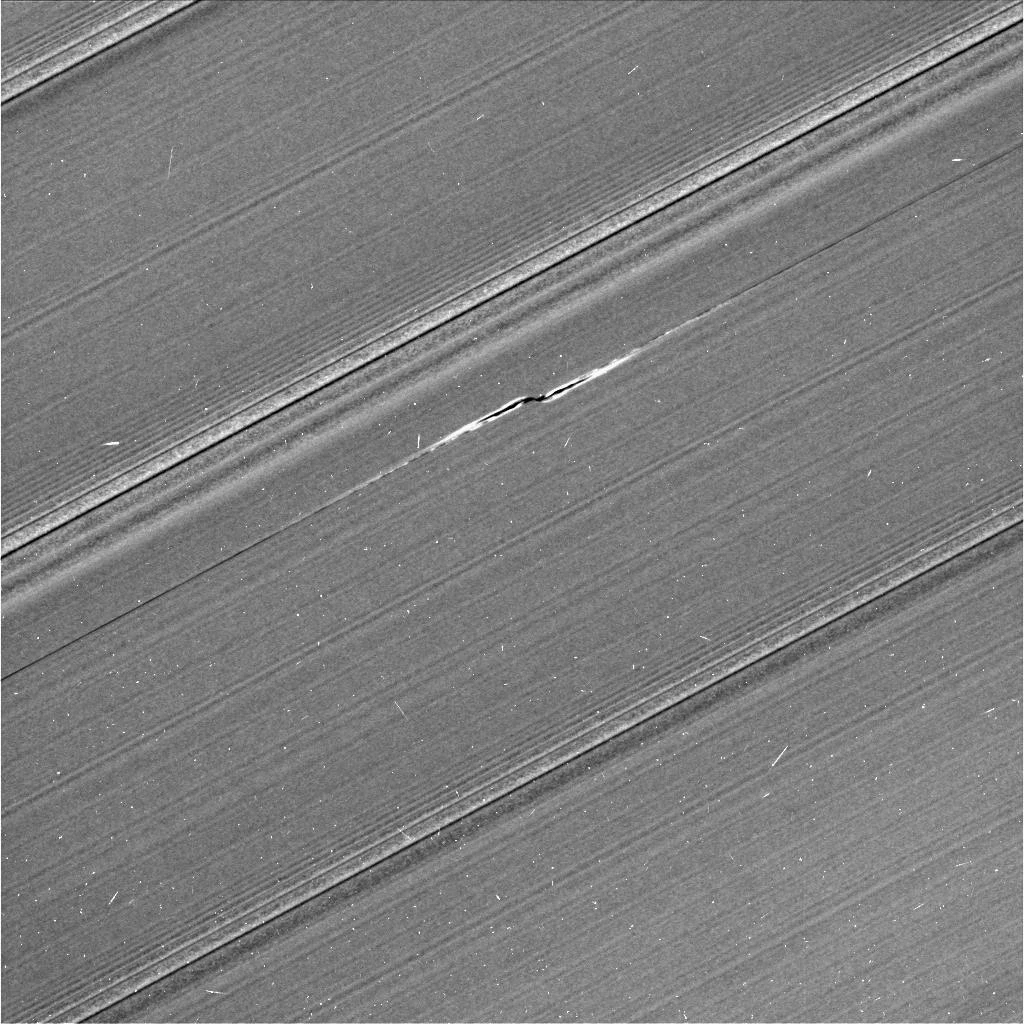
Saturn’s rings contain material from dust up to moonlets hundreds of metres across, and those moonlets are not counted. Wikipedia’s summary notes there’s no consensus on where ring material ends and moons begin, and that more than 150 embedded moonlets have been detected from the disturbances they cause in the rings (Moons of Saturn). Cassini saw some of them as “propellers,” propeller-shaped streaks in the A ring that reveal “a small moonlet embedded in Saturn’s A ring,” such as one nicknamed Bleriot (NASA Science, Bleriot Recaptured).
There’s an exception that proves how fuzzy the line is. Two B-ring moonlets, S/2009 S 1 and S/2009 S 2, are counted as regular moons, and S/2009 S 2 was the addition that took Saturn from 292 to 293. The Minor Planet Center announced it on June 17, 2026, after J. Spitale reported it in four Cassini images from 2009, orbiting within the B ring about 117,000 km from Saturn (MPEC 2026-M19).
How Do Astronomers Find New Moons?
Modern moon hunting looks nothing like Galileo’s first view of Jupiter’s four big moons, the first moons discovered beyond Earth, in January 1610 (NASA Science, Jupiter Moons). Today it’s a data problem.
- Image the space around the planet, deeply. Teams use large telescopes such as the 8 m Subaru and 6.5 m Magellan–Baade for Jupiter, and the 3.5 m Canada-France-Hawaii Telescope for Saturn (Space.com).
- Look for motion. In the 2019 Saturn search, images were taken about an hour apart: background stars and galaxies stayed fixed, while each new moon “shows motion between the two images” (Subaru Telescope).
- Shift and stack. For moons too faint to see in one frame, astronomers shift a series of images at the rate a moon would move, then stack them so its faint light adds up. Ashton’s team used this “shift and stack” approach (Gizmodo), combining multiple images “to strengthen an astronomical object’s signal” (UBC).
- Come back, again and again. Ashton’s team monitored Saturn’s surroundings from 2019 to 2021, then revisited the same sky fields for three consecutive months in 2023 (UBC). Repeated sightings turn a moving dot into an orbit.
- Submit to the Minor Planet Center. The MPC checks, computes and announces. Only then does the moon count.
Space telescopes help too. NASA’s Uranus page lists S/2025 U1, discovered in 2025 and linked to NASA’s report “New Moon Discovered Orbiting Uranus Using NASA’s Webb Telescope” (NASA Science, Uranus Moons). And new survey machines are coming online: EarthSky notes that the Vera C. Rubin Observatory, online since June 2025, has been issuing alerts about moving objects in the sky (EarthSky).
The measurement side of astronomy runs through all of this. If you like knowing how a number is earned, our guide to how astronomers measure stars uses the same evidence-first approach.
How Many Moons Do Dwarf Planets Have?
Dwarf planets aren’t in the eight-planet table, but several have moons too:
| Dwarf planet | Known moons | Names | Source |
|---|---|---|---|
| Pluto | 5 | Charon, Nix, Hydra, Kerberos, Styx | NASA |
| Haumea | 2 | Hi’iaka, Namaka | NASA |
| Eris | 1 | Dysnomia | NASA |
| Makemake | 1 | S/2015 (136472) 1, nicknamed MK 2 | NASA |
Pluto’s Charon is about half Pluto’s size, which NASA calls the largest known moon relative to its parent body in the solar system (NASA, Pluto Moons). JPL’s list includes Pluto’s five, bringing its total to 460 satellites, not counting Earth’s Moon (JPL SSD). Haumea is also the first known Kuiper Belt object with rings (NASA, Haumea).
Myth vs. Fact: Moon Count Edition
| Myth | Fact |
|---|---|
| “Jupiter has the most moons.” | Not since May 2023. Saturn leads, 293 to 115 (JPL, Nov 2026). |
| “Saturn just gained 128 moons.” | They’re newly confirmed discoveries of moons already in orbit, not new arrivals. |
| “Every moon has a name.” | Only 63 of Saturn’s 293 are named. Faint moons may never be. |
| “Ring particles are moons.” | Ring moonlets aren’t counted, with rare exceptions. |
| “There’s an official size limit for moons.” | The IAU has no formal definition of a moon. |
| “The count is final.” | It’s a dated snapshot. Expect it to change. |
Moons by the Numbers
- 293: known moons of Saturn, as of November 7, 2026 (JPL SSD)
- 115: known moons of Jupiter (JPL SSD)
- 456: moons of the eight planets combined (our sum from the table above)
- 226: Saturnian moons with provisional labels only
- 63: Saturn’s named moons
- 128: Saturn moons announced on one day in March 2025 (UBC)
- 25 to 27: the magnitude range of the moons announced in March 2026 (Space.com)
- 1610: the year the first moons beyond Earth, Jupiter’s Galilean moons, were discovered (NASA)
- 0: official size cutoffs for what counts as a moon

Which Planet Has the Most Moons? FAQ
Which planet has the most moons in 2026?
Saturn. As of November 7, 2026, NASA’s JPL lists 293 known moons of Saturn, compared with 115 for Jupiter. Saturn has held the lead since May 2023.
How many moons does Saturn have?
Saturn has 293 known moons as of November 2026. Of those, 67 have permanent numbers, 63 have names, and 226 still carry provisional labels such as S/2023 S 63.
How many moons does Jupiter have?
Jupiter has 115 known moons as of November 2026, after 14 were announced in April 2026. Of those, 73 are numbered and 57 are named. Some NASA pages still show the older figure of 95.
Why do moon counts keep changing?
Because astronomers keep confirming moons that were always there. Deeper telescope surveys find fainter moons, orbits take months to years to confirm, and the Minor Planet Center announces them in batches.
What’s the difference between a confirmed and a provisional moon?
A provisional moon has a confirmed orbit and counts toward the total, but carries a temporary label based on its discovery year. Once its orbit is precise enough, it gets a permanent Roman numeral, and later perhaps a name.
Did Jupiter ever have more moons than Saturn?
Yes. Jupiter led in 2018 with 79 moons, lost the lead to Saturn in October 2019, regained it in February 2023 with 92, then lost it again in May 2023 when Saturn reached 145.
Which planets have no moons?
Mercury and Venus. Earth has one, Mars has two, and the four giant planets have between 16 (Neptune) and 293 (Saturn).
Does Pluto have moons?
Yes, five: Charon, Nix, Hydra, Kerberos and Styx. Pluto is classed as a dwarf planet, so it isn’t included in the eight-planet count.
Your next step: next time you see a moon count, look for the date. If there isn’t one, check NASA JPL’s satellite discovery list, the live list astronomers use, and compare it with the “as of” line on NASA Space Place. Then come back to the table at the top of this page: we’ll update it as new circulars land.

Sources and Further Reading
- NASA JPL Solar System Dynamics (checked November 7, 2026), Planetary Satellite Discovery Circumstances. The live list: 115 for Jupiter, 293 for Saturn, 29 for Uranus, 16 for Neptune, 460 satellites in total including Pluto’s.
- NASA Space Place (updated July 31, 2026), How Many Moons Are in Our Solar System?. Counts for all eight planets, with “as of” dates.
- NASA Science (updated September 22, 2026), Saturn Moons. “293 confirmed moons… as of August 2026.”
- NASA Science, Jupiter Moons. Galilean moons and the IAU naming policy; count not yet updated.
- NASA Science (updated September 2026), Uranus Moons, Neptune Moons, Pluto Moons.
- NASA Science (updated October 26, 2026), Eris, Haumea, Makemake.
- International Astronomical Union (March 26, 2026), MPC Announces New Moons of Saturn and Jupiter. The confirmation process and naming themes.
- University of British Columbia (March 2025), Saturn still reigns supreme as moon king with 128 new moons.
- Subaru Telescope (October 7, 2019), Discovery of 20 new moons of Saturn.
- Carnegie Science (July 16, 2018), A dozen new moons of Jupiter discovered, including one “oddball”.
- Scott Sheppard, Carnegie Science, Moons page and Jupiter moons.
- USGS Gazetteer of Planetary Nomenclature, IAU rules and conventions.
- Space.com (March 20, 2026), Astronomers keep finding new moons of Jupiter and Saturn.
- Astronomy (February 2023), Jupiter now has 92 moons, surpassing Saturn for record; Gizmodo (May 2023), Saturn reclaims most moons.
- Scientific American, What Makes a Moon?; Live Science (November 16, 2019), What is a moon?.
- Wikipedia, Moons of Saturn, Moons of Jupiter, Naming of moons. Used for announcement dates not stated on agency pages.
Explore Next
- Saturn’s biggest moon, up close: NASA’s Dragonfly Mission to Titan
- The weather at the top of both giants: Jupiter’s Polar Cyclones vs. Saturn’s Hexagon
- Our own Moon is changing too: Why Is the Moon Shrinking?
- How to read the images in this article: Are Space Photos Real?
- How a measurement is earned: How Astronomers Measure Stars
- More from the planets: Space & Planetary Worlds
How This Explainer Was Checked
Every moon count in this article comes from NASA JPL, NASA Science, NASA Space Place or the IAU, and was checked against those pages on November 7, 2026. Where announcement dates aren’t stated on an agency page, we used news releases from the discovering teams’ institutions or Wikipedia’s dated timeline, linked in place. The numbered, provisional and named counts in the main table were tallied by DCI from JPL’s satellite list on the same day. Where sources disagree, we show both numbers and explain the date gap. Images are labelled: real spacecraft or telescope images as OBSERVATION, illustrations as ILLUSTRATION, and our charts as DATA GRAPHIC. Nothing AI-generated is presented as a real image.
Final Thought: Count the Date, Not Just the Moons
The planet with the most moons is Saturn, today. The deeper fact is that every number here is a record of how hard we’ve looked. Saturn’s 293 is a census of faint rocks that took decades of telescope time and years of patient orbit-tracking to earn. When the number changes again, and it will, that’s not the solar system changing. It’s us seeing more of it.

About the Author
Author: King | Founder of Dark Cosmic Insights
King is the founder of Dark Cosmic Insights, a science storytelling platform exploring the strangest true stories hiding in space, science and AI. He digs into NASA, ESA and peer-reviewed research, separates what has been measured from what is still a mystery, and turns it into articles, data graphics and Shorts.
Follow the anomaly. Trace the source.