In 2000, magnetic measurements from a spacecraft gave scientists their best clue yet that a moon of Jupiter hides an ocean. NASA’s Galileo probe found that Europa’s magnetic field kept flipping direction in step with Jupiter’s. The simplest explanation, said lead magnetometer scientist Margaret Kivelson, was “a layer of electrically conducting liquid, such as saltwater, beneath the ice” (NASA JPL, 2000).
Twenty-six years later, NASA still calls that magnetic result “the best evidence we have for the existence of an ocean on Europa” (NASA). Other clues have piled up since. And a spacecraft is on its way to test them.
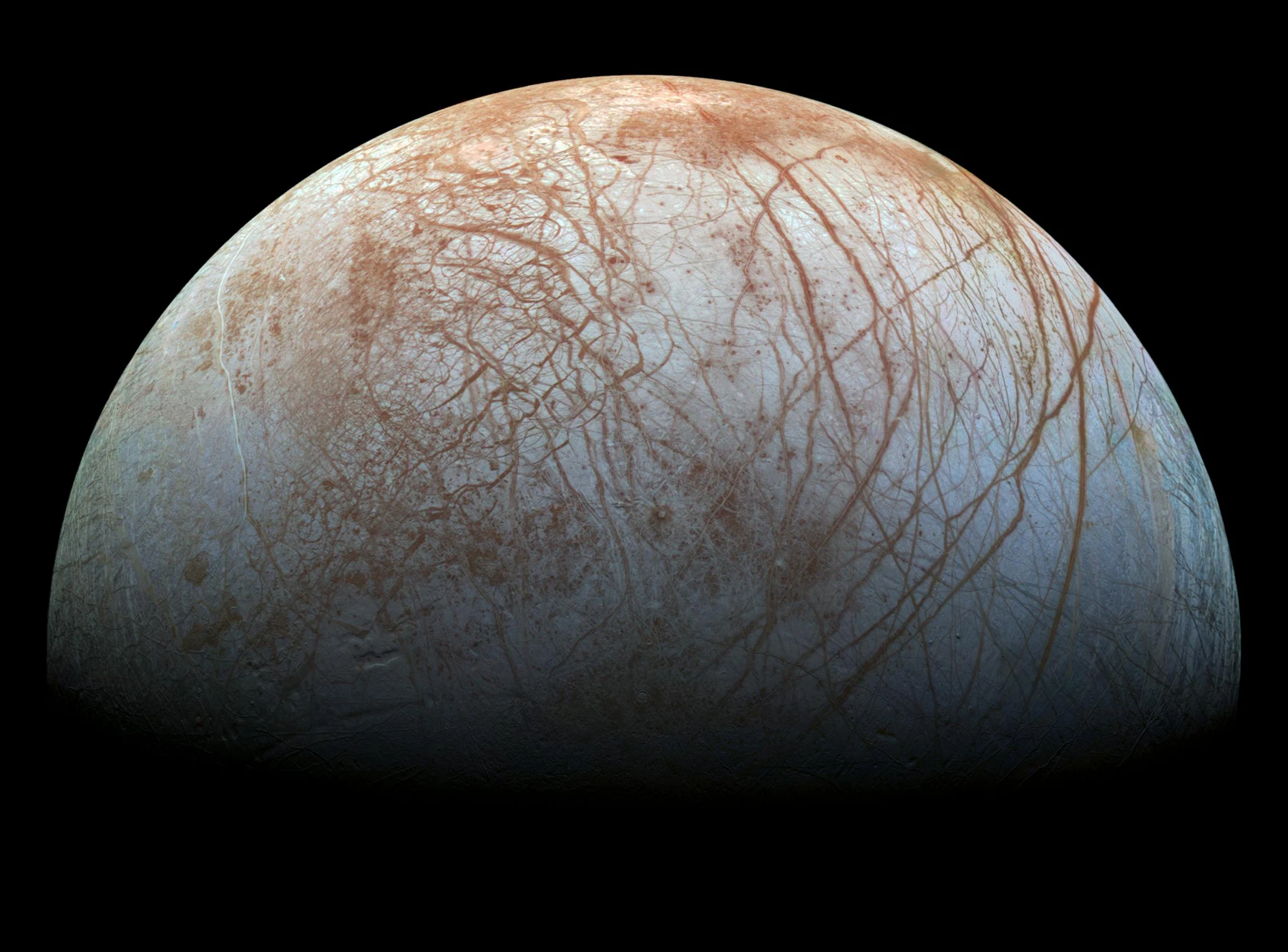
Observed, measured, modelled, open. Europa’s cracked, young icy surface is observed. Its changing magnetic field and the carbon dioxide on its surface are measured. The ocean’s existence, depth and the ice’s thickness are modelled from those measurements. Plumes are a candidate: suspected but not confirmed. Whether the ocean could support life is open.
Quick Answer: Does Europa Have an Ocean?
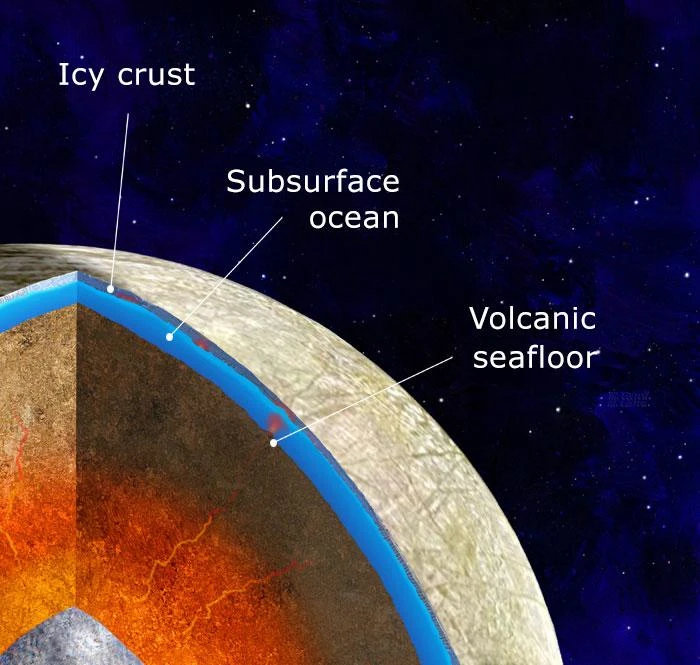
Very likely, yes. Several lines of evidence point to a global salty ocean beneath Europa’s ice. NASA says the moon’s ice shell is thought to be 15 to 25 km (10 to 15 miles) thick, “floating on an ocean 40 to 100 miles (60 to 150 kilometers) deep,” and that the ocean “may contain twice as much water as Earth’s global ocean” (NASA). No one has seen the water directly. The strongest evidence is magnetic, from NASA’s Galileo spacecraft. NASA’s Europa Clipper, launched in October 2024, reaches Jupiter in April 2030 to investigate whether Europa has places that could support life (NASA).
What this article can and cannot establish. It can lay out the evidence for Europa’s ocean, from NASA’s best evidence to the open questions, and what each line actually shows. It can’t confirm the ocean’s exact depth or the ice’s exact thickness, which are modelled, and it can’t say whether anything lives there. That’s not even what Europa Clipper is designed to find out.
Table of Contents
The DCI Evidence Map: Europa’s Ocean
| Question | What we know | Status | Key source |
|---|---|---|---|
| Is Europa’s surface young and cracked? | Yes: ridges, bands and chaos terrain | Observed | NASA |
| Does its magnetic field suggest saltwater? | Yes: an induced field that flips with Jupiter’s | Measured | NASA JPL, 2000 |
| How deep is the ocean? | Estimated 60 to 150 km | Modelled | NASA |
| How thick is the ice? | Estimated 15 to 25 km; a Juno-based model gives 29 ± 10 km for the conductive outer layer in one region | Modelled | NASA; SwRI, 2026 |
| Is there carbon dioxide on the surface? | Yes, concentrated in Tara Regio | Measured | ESA/Webb, 2023 |
| Did that carbon come from the ocean? | Likely, according to the researchers | Modelled | ESA/Webb, 2023 |
| Does Europa have plumes? | Hubble saw possible plumes; not confirmed | Candidate | NASA JPL, 2017 |
| Could the ocean support life? | Unknown | Open | NASA |
| Is Europa Clipper looking for life? | No; it’s studying habitability | Observed | NASA |
Status key: Observed = seen directly. Measured = a number with a stated uncertainty or a direct measurement. Modelled = inferred from measurements through a physical model, dependent on assumptions. Candidate = suspected from limited data, not confirmed. Open = unresolved; the evidence is incomplete or points different ways. Not supported = the evidence goes against the claim, or there is none for it.
Cite this framework: “DCI Evidence Map: Europa’s Ocean,” Dark Cosmic Insights, November 2026, darkcosmicinsights.com/does-europa-have-an-ocean/.
What Is Europa?
Jupiter’s icy moon
Europa is one of Jupiter’s four large moons. NASA says it has an equatorial diameter of about 3,100 km (1,940 miles), about 90 percent the size of Earth’s Moon, and orbits Jupiter at about 671,000 km (417,000 miles), once every 3.5 days (NASA). We cover all of Jupiter’s moons in How Many Moons Does Jupiter Have?
A shell of ice
Europa’s surface is water ice, crossed by cracks, ridges and bands. Some regions, like the chaos terrain called Tara Regio, are geologically young (ESA/Webb, 2023), a sign that the surface is still being reshaped.
Squeezed by Jupiter
Scientists think Jupiter’s gravity squeezes and relaxes Europa as it follows its slightly stretched orbit, and that this constant flexing generates heat inside, helping keep water liquid beneath the ice. This tidal heating is another effect of tides, which we explain in What Is Tidal Locking?

How Do We Know Europa Has an Ocean?
Scientists can’t drill through the ice, so the case rests on several clues. Here they are in order, from NASA’s best evidence to the open questions. Not every entry is independent evidence: the ocean’s depth is an estimate built on the clues, and life is an unanswered question.
Clue 1: the magnetic signal (measured)
Jupiter has a powerful magnetic field. As Europa orbits, the field it feels keeps changing direction. If there’s a layer of salty, electrically conducting water inside Europa, that changing field should induce a magnetic field of its own in the ocean, which flips in step with Jupiter’s.
That’s what Galileo found. JPL reported in 2000 that during a key pass, “the direction of Jupiter’s field at Europa was the opposite of what it had been during passes in 1996 and 1998,” and Europa’s own field flipped to match the prediction. Kivelson reasoned that because ice conducts poorly, “we infer that the conductor may be a liquid ocean” (NASA JPL, 2000).
The caveat at the time
Galileo’s project scientist, Torrence Johnson, was careful: “The evidence is still indirect and requires several steps of inference” (NASA JPL, 2000). That’s why we label the ocean itself Modelled, even though the magnetic signal is Measured.
Clue 2: a young, broken surface (observed)
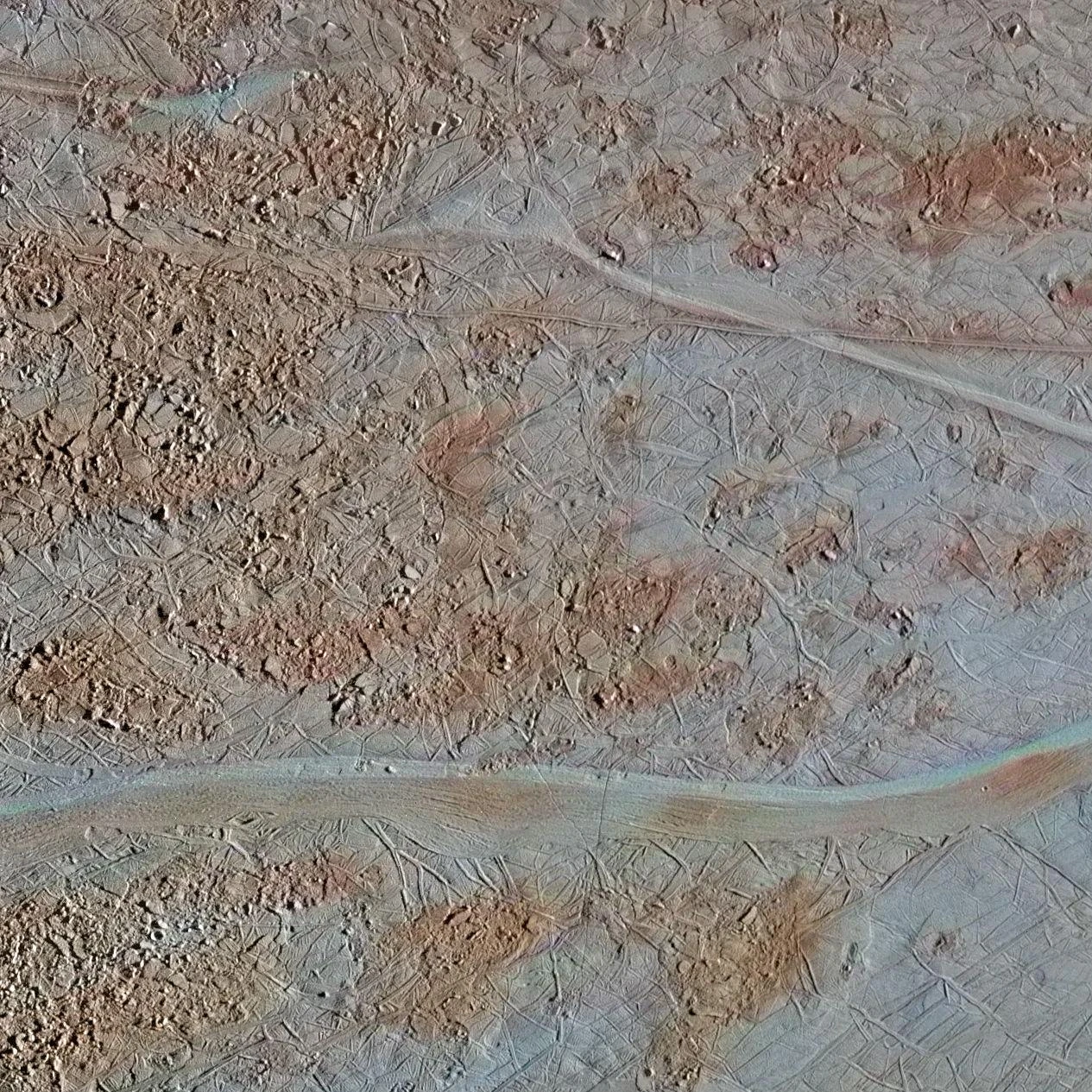
Europa’s surface shows chaos terrain, regions where the ice looks broken into blocks that shifted and refroze. Galileo images reprocessed by NASA show these jumbled areas alongside ridges and bands (NASA, PIA23873). Features like these fit ice that has been disrupted from below, though on their own they don’t prove liquid water exists today.
Clue 3: carbon dioxide on the surface (measured)
In observations made in November 2022 and reported in 2023, the James Webb Space Telescope found carbon dioxide on Europa’s surface, most abundant in a young, chaotic region called Tara Regio. The researchers concluded the carbon “likely originated in the subsurface ocean,” not from meteorites. Because carbon dioxide isn’t stable on Europa’s surface, it was likely supplied on a geologically recent timescale (ESA/Webb, 2023). The carbon dioxide itself is measured; its ocean origin is the team’s interpretation, so we label that part modelled.
Clue 4: possible plumes (candidate)
Hubble has reported possible plumes of water, including observations in 2014 and 2016. In 2016, it captured “a probable plume of material” at “the same location where Hubble saw evidence of a plume in 2014,” images that “bolster evidence that the Europa plumes could be a real phenomenon” (NASA JPL, 2017). But Webb’s observations, made in 2022 and reported in 2023, didn’t see a plume; the team noted that “their non-detection does not rule out a plume,” which may appear only at certain times (ESA/Webb, 2023). Plumes remain a candidate.

How Thick Is Europa’s Ice?
NASA’s estimate: 15 to 25 km
NASA says “scientists think Europa’s ice shell is 10 to 15 miles (15 to 25 kilometers) thick” (NASA). That’s an estimate from models, not a direct measurement through the whole shell.
Juno’s 2025 estimate: 29 ± 10 km for the outer layer
In December 2025, scientists using the microwave radiometer on NASA’s Juno spacecraft reported a model-based estimate of 29 ± 10 km (about 18 miles) for the thermally conductive outer layer of the ice, averaged over the region Juno observed during its September 29, 2022, flyby, and assuming pure water ice (Levin et al., 2025). It’s not a direct measurement of the whole shell. In the team’s words, it applies to “the cold, rigid, conductive outer layer of a pure water ice shell.” If a warmer layer lies beneath, the total shell would be thicker. Under one assumed salt concentration, the model gives an outer layer about 5 km thinner; the effect depends on the assumed salinity (Levin et al., 2025; SwRI, 2026).
Why it matters
A thicker shell would make it harder for material from the ocean to reach the surface, and harder for any future probe to reach the water. That’s one reason Europa Clipper will carry instruments designed to help “constrain ice shell thickness” (NASA).
How Deep and How Big Is Europa’s Ocean?
60 to 150 km deep
NASA describes Europa’s ice “floating on an ocean 40 to 100 miles (60 to 150 kilometers) deep” (NASA). Earth’s oceans average only a few kilometers deep, so Europa’s would be many times deeper.
Maybe twice Earth’s water
Even though Europa is smaller than our Moon, its ocean “may contain twice as much water as Earth’s global ocean,” NASA says (NASA). Note the “may”: it depends on the ocean’s depth, which is modelled.
Salty
The magnetic evidence works only if the water conducts electricity, which means it’s salty. Webb’s team also pointed to earlier Hubble detections of ocean-derived salt in Tara Regio (ESA/Webb, 2023).
Could There Be Life on Europa?
The ingredients question
Life as we know it needs liquid water, the right chemical elements and a source of energy it can use. Europa very likely has water. Webb’s carbon dioxide adds evidence for carbon. Tidal heating supplies heat, which helps keep the water liquid, but heat isn’t the same as food: life would also need chemical energy it can use, such as from reactions between water and rock. Whether Europa’s ocean has that is unknown. Whether all these ingredients come together in a way life could use is still open.
No evidence of life
No mission has detected life on Europa. The spacecraft that have visited weren’t dedicated life-detection missions. NASA has studied a Europa Lander concept that “would look for signs of life” in the surface ice, but it remains a proposal (NASA JPL).
What “habitable” means
Scientists use “habitable” to mean conditions life could use, not that life exists. That’s the question Europa Clipper is built to address.
What Will Europa Clipper Find Out?
On its way
NASA’s Europa Clipper launched on October 14, 2024, on a SpaceX Falcon Heavy from Kennedy Space Center (NASA). On March 1, 2025, it flew past Mars, whose gravity didn’t speed it up relative to the Sun; it slowed the spacecraft slightly and reshaped its orbit to line up the next step (NASA). That step is an Earth flyby on December 3, 2026, which will act as a slingshot and boost Clipper toward Jupiter, where it arrives in April 2030 (NASA).
49 close flybys
Rather than orbiting Europa, Clipper will orbit Jupiter and make 49 close flybys of Europa (NASA), some as low as 25 km (16 miles) above the surface (NASA).
Not a life-detection mission
NASA is direct about it: “Europa Clipper is not a life detection mission.” Its goal is to determine “whether there are places below the surface of Jupiter’s icy moon, Europa, that could support life,” by measuring the ocean, mapping the surface’s composition and geology, and constraining the ice shell’s thickness (NASA; NASA).

Europa vs. Enceladus: Two Ocean Moons
Europa isn’t the only moon thought to hide an ocean. Saturn’s Enceladus is the other famous example, and the evidence for the two differs in revealing ways:
| Europa | Enceladus | |
|---|---|---|
| Size | About 3,100 km across | About 500 km across |
| Best ocean evidence | Galileo’s magnetic data | Cassini’s measurement of the moon’s wobble |
| Plumes | Possible; unconfirmed | Confirmed; 101 geysers |
| Sampled directly? | Not yet | Cassini flew through the spray |
| Ice over the ocean | Estimated 15 to 25 km overall | Maybe 1 to 5 km at the south pole |
| Next mission | Europa Clipper, arriving 2030 | ESA mission under study for a launch in the 2040s; schedule provisional |
Sources: NASA, Europa; NASA, Enceladus; NASA JPL, 2014; NASA JPL, 2015; NASA, Europa Clipper; ESA.
Enceladus is much smaller, but it’s been easier to sample, because its ocean sprays out on its own. Europa is bigger, with likely far more water, but its shell is estimated at 15 to 25 km overall, while Enceladus’s ice may be only 1 to 5 km thick at its south pole. That thin spot is where Enceladus’s geysers escape; Europa’s secrets stay mostly locked under much thicker ice. We explore Enceladus in Enceladus’s Geysers.
Myth vs. Fact: Europa’s Ocean
| Myth | Fact | Status |
|---|---|---|
| “Scientists have seen Europa’s ocean.” | No; it’s inferred from magnetic data and other clues. | Modelled |
| “Europa’s ocean is confirmed to be 100 km deep.” | NASA’s estimate is 60 to 150 km, from models. | Modelled |
| “Europa definitely has plumes.” | Hubble saw possible plumes; they’re unconfirmed. | Candidate |
| “Europa Clipper will search for aliens.” | NASA says it’s “not a life detection mission.” | Observed |
| “Life has been found on Europa.” | There is no evidence of life on Europa. | Not supported |
| “Europa’s ice is thin.” | NASA estimates 15 to 25 km; a Juno-based model gives 29 ± 10 km for the outer layer in one region. | Modelled |
How Can You Follow Europa Yourself?
See it in a telescope
Even small telescopes and steady binoculars show Jupiter’s four large moons as points of light lined up near the planet. Europa is one of them, and its position changes night to night as it circles Jupiter every 3.5 days.
Watch Clipper’s Earth flyby
Europa Clipper swings past Earth on December 3, 2026 (NASA). NASA’s mission pages track its progress toward Jupiter.
Compare with Enceladus
Saturn’s moon Enceladus also hides an ocean, and it’s sending samples into space. We explain how in Enceladus’s Geysers.
Europa’s Ocean by the Numbers
| Measure | Value | Source |
|---|---|---|
| Diameter | about 3,100 km (1,940 mi) | NASA |
| Distance from Jupiter | about 671,000 km | NASA |
| Orbit | 3.5 days | NASA |
| Ice shell (estimate) | 15 to 25 km | NASA |
| Juno-based outer-layer estimate | 29 ± 10 km, one region, modelled | SwRI, 2026 |
| Ocean depth (estimate) | 60 to 150 km | NASA |
| Ocean water (estimate) | maybe twice Earth’s oceans | NASA |
| Clipper launch / arrival | October 14, 2024 / April 2030 | NASA |
| Clipper flybys | 49, as low as 25 km | NASA |
| Possible plume heights | about 160 km | NASA |
Sources checked November 2026.
Europa Ocean FAQ
Does Europa have an ocean?
Very likely. Galileo’s magnetic measurements, Europa’s young surface and Webb’s carbon dioxide all point to a global salty ocean under the ice. NASA calls the magnetic result the best evidence. No one has seen the water directly.
How deep is Europa’s ocean?
NASA estimates 60 to 150 km (40 to 100 miles) deep. That’s a model estimate, and it means the ocean may hold about twice as much water as all of Earth’s oceans.
How thick is Europa’s ice?
NASA estimates 15 to 25 km. In 2025, a team using Juno’s microwave radiometer data from a 2022 flyby estimated 29 ± 10 km for the conductive outer layer in one region, assuming pure water ice. That’s a model estimate, not a measurement of the whole shell, and a warmer layer beneath would make the total thicker. Europa Clipper will help pin it down.
Does Europa have plumes?
Possibly. Hubble saw signs of a plume in the same spot in 2014 and 2016, but Webb didn’t see one in observations made in 2022. Plumes may be intermittent. They remain unconfirmed.
Could there be life on Europa?
No one knows. Europa likely has water and carbon, and tidal heating supplies heat, but it’s unknown whether the ocean has chemical energy life could use. There’s no evidence of life. Whether the ocean could support life is an open question.
Is Europa Clipper looking for life?
No. NASA says it “is not a life detection mission.” It’s designed to find out whether Europa has places below the surface that could support life.
When will Europa Clipper reach Jupiter?
In April 2030. It launched on October 14, 2024, flew past Mars in 2025 and swings past Earth on December 3, 2026.
How big is Europa?
About 3,100 km across, about 90 percent the size of Earth’s Moon. It orbits Jupiter every 3.5 days at about 671,000 km.
Your next step: on the next clear night, point binoculars at Jupiter and look for the tiny dots lined up beside it. One of them is Europa, and beneath its ice may be more water than Earth’s oceans hold.

Sources and Further Reading
- NASA Science, Europa Facts.
- NASA JPL (August 25, 2000), Galileo Evidence Points to Possible Water World Under Europa’s Icy Crust.
- NASA JPL (April 13, 2017), NASA Missions Provide New Insights into ‘Ocean Worlds’ in Our Solar System.
- ESA/Webb (September 21, 2023), Webb finds carbon source on surface of Jupiter’s moon Europa.
- Southwest Research Institute (January 28, 2026), NASA’s Juno spacecraft measures thickness of Europa’s ice shell, on a December 2025 Nature Astronomy paper.
- Levin et al. (December 17, 2025), Europa’s ice thickness and subsurface structure characterized by the Juno microwave radiometer, Nature Astronomy.
- NASA Science, Europa Clipper; Europa Clipper Mission FAQ.
- NASA (2025), NASA’s Europa Clipper Uses Mars to Go the Distance.
- NASA JPL, Europa Lander (concept).
- NASA images: PIA19048, PIA23873, PIA24477, Europa Clipper launch, PIA21443.
Explore Next
- The other ocean moon sending out samples: Enceladus’s Geysers
- Europa’s family: How Many Moons Does Jupiter Have?
- The planet that squeezes it: Jupiter guide
- How gravity flexes moons: What Is Tidal Locking?
- Water elsewhere in the solar system: Was There Water on Mars?
- What “habitable zone” and “chaos terrain” mean: Space Glossary
- How a claim earns its label: How We Know
How This Explainer Was Checked
Every number and quote in this article was checked in November 2026 against the source linked beside it: NASA’s Europa facts, NASA JPL’s 2000 Galileo release and 2017 ocean-worlds release, ESA/Webb’s 2023 carbon dioxide release, SwRI’s 2026 release on the Juno ice-shell paper, and NASA’s Europa Clipper pages and FAQ. The surface is labelled Observed; the magnetic signal and surface carbon dioxide Measured; the ocean, its depth, the ice thickness and the carbon’s ocean origin Modelled; plumes Candidate; habitability Open. Images are labelled: real spacecraft and telescope images as OBSERVATION, illustrations as ARTIST’S CONCEPT, our charts as DATA GRAPHIC. Nothing AI-generated is presented as a real image.

Final Thought: A Sea We’ve Never Seen
No one has ever seen Europa’s ocean. We know it the way you’d know about a room behind a closed door: from the echoes, the warmth, the things that leak out. A magnetometer reading, a few odd puffs of vapor and a whiff of carbon dioxide all point the same way. In 2030, Europa Clipper arrives to listen more closely.
About the Author
Author: King | Founder of Dark Cosmic Insights